The Silent Throttle: How the Wrong Memory Card Is Sabotaging Your Expensive Camera
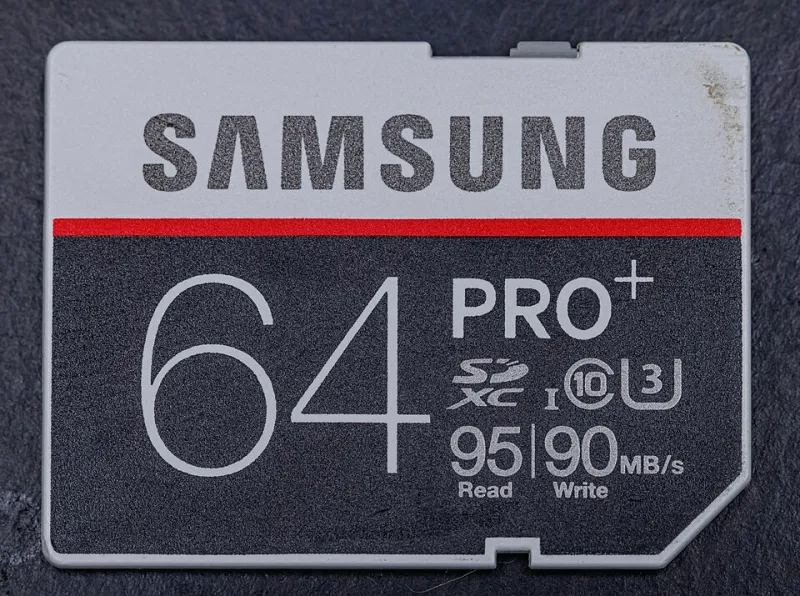
Photo: Dinkun Chen, CC BY-SA 4.0, via Wikimedia Commons
Here's an uncomfortable experiment: check the memory card in your camera right now. If it came free with the body, or cost less than lunch, there's a decent chance it's quietly capping the performance of a $2,000+ machine.
Memory cards are the least glamorous component in photography and one of the most consequential. The jargon — UHS-I, UHS-II, V30, V90, CFexpress Type B — reads like alphabet soup, but each of those labels maps directly onto whether your camera clears its buffer in two seconds or twenty. Let's decode it.
Speed Classes, Translated Into English
Every card carries two numbers that matter, and they measure different things.
The V-rating (Video Speed Class) is a guaranteed minimum sustained write speed. V30 promises at least 30 MB/s sustained; V60 promises 60; V90 promises 90. This is the number that matters for video, because video recording fails catastrophically if the card can't keep up — the camera simply stops, mid-take.
The bus type (UHS-I vs. UHS-II) is about the card's maximum potential. UHS-I tops out around 104 MB/s. UHS-II adds a second row of pins and pushes theoretical limits past 300 MB/s. You can spot UHS-II cards by the extra contact pins on the back.
CFexpress abandons the old bus entirely, using PCIe lanes for speeds in the gigabytes-per-second range. It exists because modern stacked sensors can generate data faster than SD infrastructure can handle.
The trap: a card can advertise "300 MB/s" on the front — that's the read speed, useful for offloading to your computer — while its sustained write speed is a fraction of that. Always look for the V-rating and the sustained write spec, not the big number on the packaging.
What Actually Happens When the Card Can't Keep Up
When you fire a burst, frames pile up in the camera's buffer — onboard memory that's fast but tiny. The card's job is to drain that buffer so the camera can keep shooting.
A slow card means the buffer fills, and the camera either slows its frame rate to a crawl or locks up entirely while 'busy.' On a wildlife shoot, that's the difference between a 40-frame burst on a takeoff sequence and eleven frames and a frozen camera. For sports, it's the decisive moment lost to a buffering icon.
Video is even less forgiving. 4K at high bitrates — especially 10-bit 4:2:2 — demands sustained throughput. A V30 card might handle standard 4K; it will choke on a camera's highest-quality modes. And here's the detail that stings: this throttling doesn't feel like a gear failure. It feels like 'my camera is slow,' and people blame the body.
Which Specs You Actually Need
Match the card to the mission:
- Casual, landscape, travel stills: UHS-I V30 is genuinely fine. Don't overspend.
- Sports and wildlife bursts: UHS-II V90 minimum. The buffer clears dramatically faster, and back-to-back bursts stay fast.
- 4K 10-bit video: V60 at minimum, V90 to be safe at high bitrates.
- High-resolution video (6K/8K) and flagship bodies: CFexpress Type B, no way around it.
Pairings for US Shoppers, by Budget
Budget tier (~$25–40): For an entry body like a Canon R50 or Sony a6400, a pair of SanDisk Extreme Pro UHS-I V30 cards (128GB) covers stills and standard 4K with room to spare. Buy two — one in the camera, one in the bag.
Mid tier (~$60–100): Shooting a Canon R6 II, Sony a7 IV, or Fujifilm X-T5 seriously? Sony Tough UHS-II V90 or ProGrade V90 128GB cards. The Sony Tough cards are also rated for bending and submersion, which matters more than you'd think.
High tier (~$150–300): Nikon Z8/Z9, Sony a1, Canon R3 and R5 II with high-bitrate video — ProGrade Cobalt 650x CFexpress Type B or Sony TOUGH CFexpress. These bodies are throttled by anything less; a V90 SD card in a Z9's CFexpress slot is putting economy tires on a race car.
One last tip: whatever you buy, get it from a US authorized retailer. Counterfeit SanDisk cards are rampant on third-party marketplaces, and a fake card fails exactly when it matters most.
Your camera is only as fast as the card you feed it. Feed it right.